ICfE
Industrial Copilot for Engineering
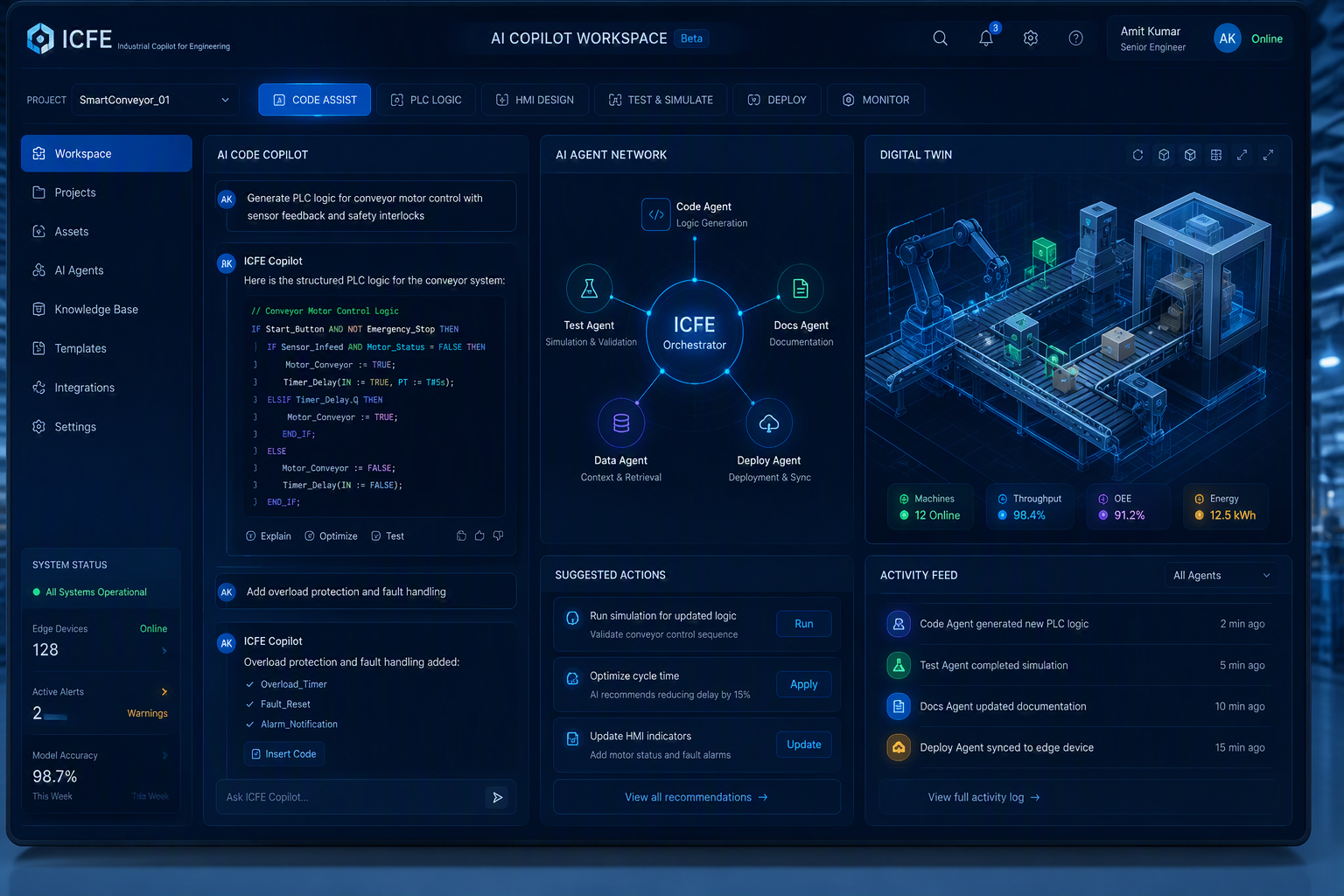
An agentic AI system embedded directly in the TIA Portal IDE that enables engineers to write PLC and HMI code 30-40% faster with enterprise-grade safety guardrails, audit logging, and governance controls.
Key Metrics
Reduction in code generation time on $50K-$500K projects
Adherence to enterprise standards and best practices
Tracked across safety, performance, and governance
Use Cases
PLC Code Generation
Engineers describe the control logic requirements in natural language. ICfE generates structured, optimized PLC code with proper error handling, safety interlocks, and documentation. The system understands domain-specific patterns and automatically applies industry best practices.
HMI Interface Design
Automatically generate HMI screens and layouts based on process descriptions. ICfE suggests intuitive widget placement, follows ergonomic standards, and ensures consistency with enterprise UI guidelines. Engineers can iterate quickly without manual layout work.
Safety and Compliance Review
Built-in governance layer ensures all generated code meets safety standards, includes required interlocks, and maintains audit trails. System flags potential compliance issues before deployment and generates compliance documentation.
Project Knowledge Transfer
Capture institutional knowledge about legacy systems and best practices. ICfE maintains context across projects, enabling faster onboarding and consistent engineering patterns across the organization.
Architecture Overview
AI Foundation Layer
ICfE leverages large language models with specialized fine-tuning for industrial automation. The system combines conversational understanding with domain-specific knowledge to generate accurate, context-aware code. Models are optimized for low-latency responses to maintain interactive developer experience.
Context Management
The system maintains intelligent context across five dimensions: chat history for conversational continuity, document libraries for reference materials, project structure understanding, tool capabilities, and metadata about standards and constraints. This multi-layered context ensures generated code aligns with project-specific requirements and organizational standards.
Agentic Execution
Beyond single-turn generation, ICfE acts autonomously within safe boundaries. It can iteratively refine code, validate against standards, suggest optimizations, and explain design decisions. The system respects enterprise governance policies and never makes changes without explicit user approval.
Real-time Execution & Validation
Generated code can be immediately tested within the simulation environment. ICfE validates syntax, checks for runtime errors, ensures compliance with safety standards, and provides detailed execution traces. This tight feedback loop accelerates development and catches issues early.
Enterprise Governance
All interactions are logged for audit trails. The system enforces role-based access controls, maintains compliance records, and tracks all code modifications. Governance rules ensure that generated code meets security and safety standards before deployment.
Technology Stack
AI/ML
- •Large Language Models
- •Agentic AI Frameworks
- •Context Management
- •Prompt Engineering
Backend
- •Python 3.12
- •Async Processing
- •AWS Infrastructure
- •Real-time APIs
Frontend
- •IDE Integration
- •WebView2 Technology
- •React Components
- •Real-time UI Updates
Infrastructure
- •AWS ECS Fargate
- •DynamoDB
- •S3 Storage
- •Load Balancing
Business Impact
ICfE delivers measurable productivity improvements across engineering teams. Projects that typically require 3-4 weeks for PLC and HMI development can now be completed in 2-3 weeks, maintaining or exceeding code quality standards. The time savings scale with project complexity, showing the greatest benefits on larger automation systems.
Beyond raw development speed, the system eliminates repetitive work, reduces human error, and ensures consistent application of engineering standards. Teams spend less time on boilerplate code generation and more time on complex logic and system optimization. This reallocation of effort leads to better overall system design.
The enterprise governance layer provides organizations with confidence in AI-assisted development. Every generated artifact is auditable, reversible, and compliant with organizational policies. This enables broader adoption of AI-assisted engineering practices while maintaining strict control and oversight.
Interested in AI-Assisted Engineering?
Let's discuss how AI can accelerate your industrial automation projects.
Start a Conversation